
Reading time: ~10 minutes
Audience: Founders, CMOs, and owners deciding how to split budget between Google Ads and SEO.
Table of Contents
Should you budget Google Ads or SEO first in 2026?
Budget Google Ads first if you need qualified leads this month and your offer plus landing page can convert. Budget SEO first if you have a longer runway, a site that can rank, and you want a lower cost per lead over 6–12 months. Most businesses should not pick only one: ads buy speed; SEO buys ownership of demand.
This is the decision a digital marketing agency should make with you before scaling spend. Channel choice without conversion tracking and a clear offer is how budgets disappear.
Key Insight: Google Ads vs SEO is not a rivalry. Ads tell you which messages convert. SEO turns the winning messages into pages you do not rent forever.
Google Ads vs SEO: the real difference
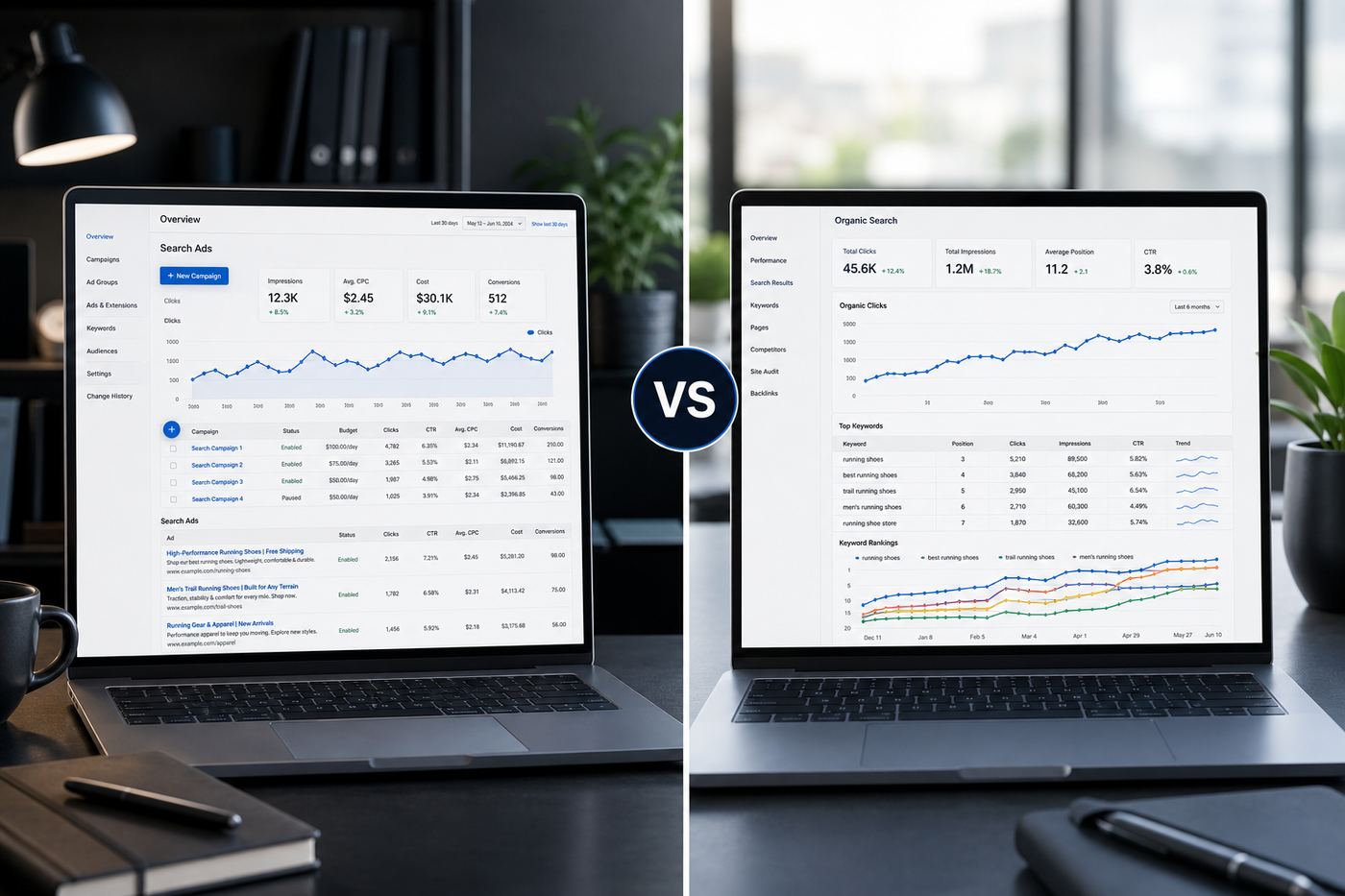
Google Ads (paid search) puts your offer on high-intent queries immediately. You pay per click. When you stop paying, most of that traffic stops. SEO (organic search) earns listings through relevance, technical health, content, and trust. You pay with time and expertise. When it works, traffic can continue without a daily media invoice.
In 2026 both channels sit next to AI Overviews and social discovery. That does not make paid search useless, and it does not make SEO dead. It means landing-page quality, clear answers, and measurement matter more than they did when “rank #1” was the whole strategy.
If you also run Meta, treat it as demand creation. Google Ads and SEO still capture people who are already searching. See how Nexus structures this in SEO & Paid Ads.
When Google Ads should get budget first
Choose Google Ads first when speed is the constraint: a launch, a seasonal window, a sales team waiting on pipeline, or a market (USA, UAE, UK, Pakistan) where competitors already occupy organic results. Ads also make sense when you are still testing price, offer, or audience and cannot wait months for a content program to teach you what converts.
- You can name a conversion (form, WhatsApp, call, purchase) and track it in GA4.
- Your website or landing page matches the ad promise.
- Margins support a test budget for at least 3–4 weeks.
- You need coverage on brand terms so competitors cannot siphon your name.
Google Ads is a poor first move when tracking is broken, the page is slow, or the offer is unclear. Paid traffic then just multiplies a conversion problem. That is why paid media and UX belong together—see the ROI of UX architecture for paid ads.
When SEO should get budget first
Choose SEO first when you can wait for compounding results, you sell a considered service, and search demand is stable (agencies, software, healthcare, education, professional services). SEO is also the better long-term cost structure once you rank for queries that already convert in ads.
- Your site can be crawled, is mobile-fast, and has a clear service structure.
- You can publish useful pages that answer real buyer questions—not generic filler.
- You need visibility in classic results and in answer-style / AI-assisted search (AEO/GEO).
- Local or multi-country pages matter (Pakistan, UAE, USA) and you can support them honestly.
SEO is a poor first move when the business needs revenue in 14 days, the website cannot convert, or nobody will maintain content. Rankings without a path to inquiry waste the work.
Google Ads vs SEO: side-by-side
| Factor | Google Ads | SEO |
|---|---|---|
| Time to first leads | Days, if tracking and pages are ready | Usually months |
| Cost pattern | Ongoing media spend | Upfront work, then lower marginal cost |
| Control | High: bids, budgets, queries | Lower: Google’s ranking systems |
| Durability | Stops when spend stops | Can persist and compound |
| Best use | Speed, tests, brand defense | Ownership of demand, trust, lower CPA over time |
A practical budget split for 2026
There is no universal percentage. Use this starting logic, then adjust with data:
- Need leads now: roughly 60% Google Ads / Meta, 40% SEO + conversion fixes.
- Stable pipeline, high CAC: shift toward 50/50, then more SEO on queries that already convert.
- Strong organic, weak coverage: keep a smaller always-on ads layer for brand, competitors, and remarketing.
Do not fund ads and SEO as two disconnected retainers. The same offer, the same landing pages, and the same conversion definition should sit under one plan. That is the difference between a channel vendor and a full-service digital marketing agency.
Need a split you can actually run? Book a free discovery call — Nexus maps SEO, Google Ads, and landing-page gaps in one view.
What to measure so you do not waste money
Vanity metrics hide the truth. Rankings and cheap clicks are not a business result. For Google Ads, watch qualified CPA, conversion rate, and lead quality (not just form volume). For SEO, watch organic leads from money pages, not only traffic. For both, confirm WhatsApp, calls, and forms are in the same CRM or inbox so you can compare channels fairly.
Also measure the page, not only the click. If ads send traffic to a weak homepage, you will blame Google Ads. Often the fix is web design and CRO, not a bigger bid.
Want SEO and Google Ads working as one system?
Nexus Digital Marketing builds tracking, landing pages, and search campaigns together—so spend creates pipeline, not reports.
Book a free growth auditFAQ: Google Ads vs SEO
Is SEO or Google Ads better in 2026?
Neither is universally better. Google Ads is usually better when you need leads this month. SEO is usually better when you need lower long-term cost per lead. Most growing businesses should use both, weighted to today’s constraint.
How long does SEO take compared with Google Ads?
Google Ads can generate traffic within days once tracking and landing pages are ready. SEO typically takes months to compound in competitive markets. Plan ads for speed and SEO for ownership of demand.
How should a small business split budget?
A common start is 60% paid media and 40% SEO/web conversion when you need leads now, then reverse the mix as organic rankings stabilize. Margins, sales cycle, and country competition change the ratio.
Can I pause Google Ads if SEO starts working?
You can reduce spend. Pausing entirely often removes coverage for queries you still do not rank for, plus remarketing and brand defense. Keep a smaller always-on paid layer.
Do Google Ads help SEO?
Ads do not buy organic rankings. They fund tests: which offers and pages convert. Those learnings make SEO pages stronger, so paid and organic work as one system.
Should startups choose SEO or Google Ads first?
If you need pipeline this quarter, start with Google Ads plus a conversion-ready page, then SEO the queries that already convert. If you have a longer runway, you can invest in SEO earlier.
Is Google Ads still worth it with AI Overviews?
Yes. Paid search still captures high-intent buyers, including queries where organic space is crowded. Success depends on tracking, landing-page quality, and offer strength—not only bids.
What should an agency measure?
Measure both channels against qualified leads or revenue. Ads: CPA, ROAS, conversion quality. SEO: converting queries, organic pipeline, assisted conversions—not vanity traffic.
Google Ads vs SEO is a sequencing decision, not a loyalty test. Get speed where you need it, build durable search where you can own it, and connect both to pages that convert. That is how Nexus Digital Marketing runs SEO and paid ads for businesses worldwide.